My first ever Internet film review (1996)
Original Published Date : 2020-05-24
As I’ve said before, the Internet is not the Web. The Internet came first. The first browser (Mosaic) came out in about 1993. From memory, even by 1994 the Web and the browser hadn’t landed on my radar. The Internet had, via News Groups; aka Usenet.
It was a bit like a Forum and I used a dedicated Windows program to read and write messages to News Groups. They had names like rec.sport.football.australian and rec.arts.movies The rec meant recreation. There were also comp. (computers), sci. (science) , alt. (alternative) etc ‘trees’ of News Groups.
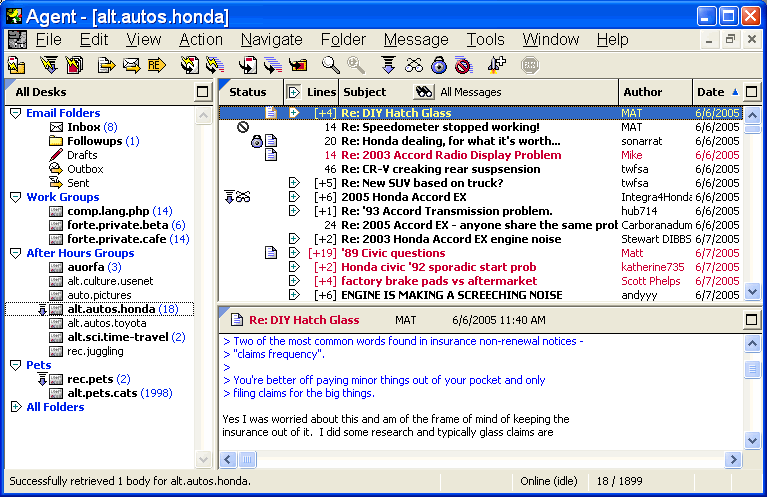 Agent, the exact program I use to use. Image from here
Naturally, I gravitated to the movie ones. My first Usenet post was on 4/6/1994 and it was a question on a French film I’d just seen; Le Samourai.

It’s true – you can’t hide from Google – because here it is:
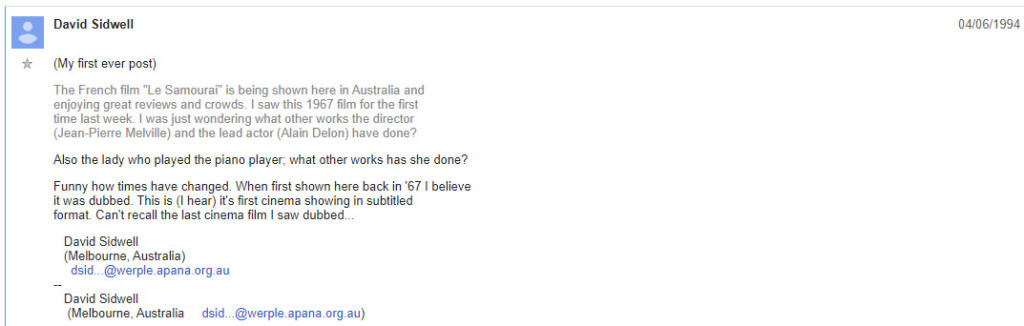 I didn’t put up that many posts, but by August 1996 I must have worked up the confidence to write my first ever Internet film review. And what a movie to start with. Here it is (text unedited), from August 15th 1996.
SHINE
A film review by David Sidwell
Copyright 1996 David Sidwell
Directed by: Scott Hicks
Rating: 4.5 out of 5
Starring: Geoffrey Rush, Noah Taylor, Lynn Redgrave, John Gielgud
There is a lovely magic at work here.
We share the descent into darkness of a talented boy pianist. Years later we see his subsequent resurfacing; in the mid 80’s a damaged man walks out of a rainstorm and back into the world.
The movie charts the causes of his mental breakdown.
Based on the life story of David Helfgott, this Australian film is a rich exploration of the pressures drilling in upon a child-genius, compounded by the looming shadow of a domineering father.
In the 1950’s Helfgott emerged as a child prodigy. The film traces his relationship with his father, whose encouragement comes at the cost of demanding David have no life beyond that of the black and white keys.
David is offered places in the USA, but his father refuses to let him leave Australia. The effect this has upon Helfgott is cleverly told via a single reverse tracked shot; David is sobbing on the front doorway of his music teacher’s house. He is well lit via the external house lights. His teacher isn’t home. We pull back and see that the dark front room’s window has it’s curtains open. There, in a pool of blackness, is a Grand Piano. David’s fall over the dark cliff has begun.
Instead of being told in a linear mode, SHINE jumps around in time, ala “Pulp Fiction”. This narrative device works well; we see David as a boy, teenager in London and mental-patient in various snippets. The film then neatly loops back for its uplifting conclusion. Adult-Helfgott’s return to the light is told in linear fashion.
The lead role is played by 3 different actors, with the teenage-David (Taylor) and adult-David (Rush) standing out. Whilst Rush is known for his TV work in Australia, I think this is his first major cinema work. His David, whilst clearly damaged – he keeps quoting his “daddy” in a babbling word torrent, cuddles strangers and grabs women on the breasts – is both touching and funny.
Taylor’s teenage-David is the more sympathy producing role. We are mute witness to his gradual breakdown as the pressures just keep on building. His father wants him to play the very demanding Rachmaninov’s 3rd, whilst his teacher wants to start him with a simple Mozart.
Technically this is a beautiful film and a lot of thought has gone in to the production. I particularly like the use of slow motion and sound effects.
One scene has adult-Helfgott happily babbling in a car in the rain. The sound of the windshield wipers fades up over his voice. With a clever subtlety, the wiper sound appears to morph into a rhythmic thumping, but of the same beat. The image dissolves and we realise the thumping is the slow motion applause of a crowd. But it’s US being clapped. WE are young-David walking up to the stage for our first public show.
The music, as you would expect from a film of this subject matter, is critical. And it works very well. The ‘miming’ of the actors piano playing is faultless (apparently Rush didn’t mime; he really did play)
Helfgott’s life is certainly not without it’s sympathetic people. Indeed his return to the ‘normal’ world is accelerated by his chance meetings with two very special women.
His ultimately uplifting story is a magic piece of theatre craft. It shows that with the ‘help of God’ we can all find our way back home.
Footnote: the real David Helfgott is still playing. He has just started a series of recitals here in Australia.
David Sidwell
(Melbourne, Australia)
e-mail: dsid…@connexus.apana.org.au
WWW: http://connexus.apana.org.au/~dsidwell